

Is It Cancel Culture?
Charlie Kirk’s death, public celebrations, and the lines between cancel culture and social correction.

Cancel culture is back in the headlines.
Charlie Kirk’s assassination shocked the nation and revealed a sharply divided public.
Most responded with grief, solemn condolences, or anger at an evil act—responses you’d expect from the most public murder in generations.
Others celebrated or excused his death, while some called for further violence.
Conservatives responded by exposing those public celebrations and justifications of murder to employers. Now, reportedly thousands of people on the left have been fired.
Liberals and libertarians are claiming this is a hypocritical use of cancel culture.
Answering that accusation matters, because how we label and respond to these actions will shape our future.
Will we become a society that shares common values and works out problems with words, or fall into a hell where violence replaces debate?
And what’s a Christian response in this battle?
Our children are watching, and how we respond shapes them, too.
Strap in, we’re going long on this one to get at the core of the issue.
If it’s too long, here’s a chart of the points I’m making.
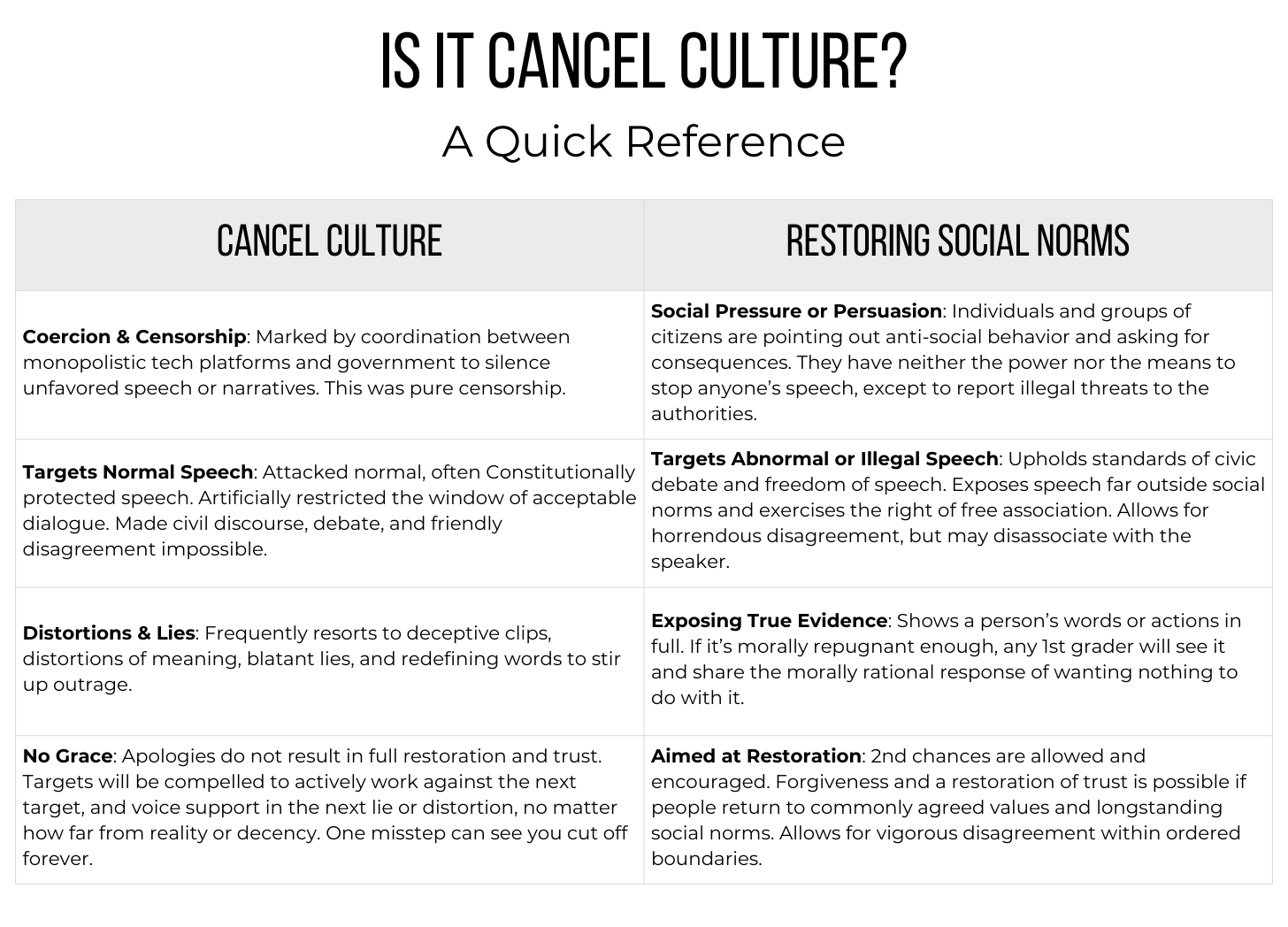
The Reality of Norms
For generations and centuries, human societies have always set boundaries for what is acceptable speech and behavior. That’s not unusual. That’s normal.
It’s so normal, it’s been compared to a culture’s immune system.
Those norms hold communities and countries together, preventing them from spiraling into chaos and destruction.
Society sets the norms. And the bulk of those norms have been very similar throughout cultures and across time. Different cultures have drawn those lines in different places, especially in manners and traditions, but the core things of life, respect for life, family, and honor have been nearly universal.
The Bargain of Civilization
Because of this consistency within human societies, you can think of it like a bargain:
If you want the benefits of community—mutual protection, cooperation, trade, friendship, etc—then there are limits to speech and behavior.
Things you’re expected to do
Things you’re discouraged from doing
Things that might be tolerated with a raised eyebrow
And things that cross the line so far that society says, “No!”
That’s the societal bargain: live within the realm of what’s acceptable and you share in the benefits of community and civilization. Stray too far afield, or blatantly break the contract of these norms, and risk ending up as a pariah or a criminal.
Anti-social is a good description for those formerly willing to break the norms. Anti-social behavior wasn’t just rude or inconsiderate. It was against society.
By acting in those ways, you are rejecting society and any moral claim it has to mold or modify your behavior. It fits human nature for those getting along in society to protect themselves by excluding those whose actions reveal a desire to destroy all those benefits.
We’re not exploring the right or wrong of this yet, just observing general experiences.
And the observable truth of norms within a cultural contract helps us understand why cancel culture became so popular and effective. It even felt potentially reasonable because—on the surface—it looked like the social immune response within the digital age.
The vague definition(s) of cancel culture contributed to its apparent normalcy.
Let’s clarify the definition so we can discern if it’s just cultural norms, or something different.
The Cancel Culture Conservatives Objected To
Wikipedia talks about cancel culture in terms as discussed above: “a cultural phenomenon in which people criticize an individual thought to have acted or spoken in an unacceptable manner, and call (typically over social media) for the target to be ostracized, boycotted, shunned or fired.”
This sounds like the normal “social immune system.”
But conservatives noticed something different when Cancel Culture hit the lexicon:
On the surface, it looked like individuals expressing displeasure. But behind that social pressure, powerful organizations and government actors pulled the strings in the shadows. Scratch the surface, and it looked more like top-down censorship.
It resembled targeted, coordinated, premeditated attacks designed to make an example of someone—not to reform their speech back to the norm—but to send a message to everyone else.
It felt like a warning. Because it was.
Cancel culture went beyond social pressure. It twisted this natural function of society into an abusive weapon of political power.
How?
By rapidly and artificially restricting the window of acceptable speech and then wielding the policies of monopolistic tech companies and political authorities to enforce the new definitions of normal—and sometimes new definitions of reality.
Cancel culture was an attempted revolutionary hijacking of social norms.
It’s aim was to rewrite the rules and reshape society according to a progressive worldview.
How do we know? Let’s look at the differences.
Difference #1: Coercion vs Persuasion
Cancel Culture was a top-down power play to control everyone else, even to the point of legal coercion. Traditionally, social norms were created organically, through shared values and community traditions, and enforced through relationships, dialogue, and soft pressure.
Historically, when someone stepped outside the community bounds, it was neighbors, family, and community members who responded. And even then, compassion often remained. Someone might be outcast, but rarely erased.
Even political exiles had friends closer to society’s edge to support them. And remember, the goal of social pressure was to protect the society and bring the offender back into the fold.
Cancel culture, though, weaponized the process. It was coordinated and planned. It wasn’t individuals saying, “That crosses the line.” It was Big Tech and Big Government, often hand in hand, using compulsion and coercion to destroy people and rewrite the rules of society.
How do we know? Government agencies coordinated with social media companies to police speech, claiming it was to reduce misinformation and disinformation.
A court ruled that they crossed the line into viewpoint suppression. The 5th Circuit upheld most of that ruling.
Here’s an old media take on that decision after years of most outlets denying it was a problem. The “Twitter Files” show how common the collusion was between tech and gov, going so far as suppressing legitimate news stories, in addition to normal citizens.
The element of coercion is key in spotting the difference.
Social pressure is powerful, but it’s no match for the force of Big Tech and political connections, let alone legal pressure.
Difference #2: Targeting Normal vs Abnormal Speech
Cancel culture targeted normal speech and civic discourse, making it a threat to both the concepts of free speech and civil society. Traditional community enforcement allowed a broad window of normal speech, and reserved reproach and rejection for things that feel far outside that window.
Cancel culture activists didn’t just go after illegal speech, such as promoting violence, slandering, threatening others, or disclosing national security secrets.
They went after normal conversation: political debate, conscientious objection, comedy, policy differences, and moral perspectives grounded in historical tradition.
Examples?
Brendan Eich, CEO of Mozilla Firefox. Years after he privately donated to a legitimate political ballot measure, he was forced out of his company—not for anything illegal, not even immoral, but for holding a moral view that the voters agreed with.
Colorado cake decorator, Jack Phillips (and multiple other small business owners) dragged through years of legal battles for exercising conscientious objection and other 1st amendment rights deeply rooted in American tradition. Even after the Supreme Court had ruled in his favor.
Brett and Heather Weinstein, both liberal professors in biology faced accusations of racism after refusing to sign onto an equity manifesto that deemed everyone “allies or enemies.”
In each of these cases—and countless others—normal, legal, and traditionally accepted speech or behavior[1] was reclassified as horrendously immoral, dangerous, and worthy of cancellation.
The mechanism may have differed—corporate boards and shareholders, campus mobs and administrators, activists and lawyers—but the targeting of normal, protected speech remained.
Why? Because the Overton Window had been artificially restricted and shoved way to one side of the political spectrum. That was cancel culture: not a community enforcing shared standards, but raw power compelling compliance, even rewriting morality itself.
Difference #3: Fabricating vs. Exposing
Cancel culture often distorts, twists, or repackages the target’s words or actions to stir up a group reaction. It sometimes relies on outright lies. Traditional social pressure exposes what the problematic things that were said or done and presents the case for why it’s wrong.
Many of the average people targeted for cancelation over the last five years did nothing worse than ask unpopular questions.
What did they question? Official advice that didn’t make sense to them. Advice that kept changing. Advice delivered with the absolute conviction of authority with almost every change.
At best, it was false confidence and bravado. At worst, it was politically motivated prescriptions with a fake veneer of science. The cancellers even shouted down equally qualified doctors and researchers who disagreed with the official recommendations.
This is not how science is done.
Commonly in Cancel Culture, public statements are clipped, cut, or distorted to make the target look worse than they are. The persistent fear of being taken out of context voiced by conservative commentators is one piece of evidence that this happens.
But there’s also overt examples like Gina Carano’s firing by Disney over a misrepresented tweet. The basic message was this: don’t let the government convince you to hate your neighbor because they have a different view.
Here analogy was controversial: the long campaign of hate against Jews in pre-war Germany. But it still logically follows. Don’t do violence against your neighbors because the government told you they were bad—whether it’s a racial or ideological reason.
The message was twisted into “Gina Carano said being Republican is just like being Jewish under the Nazis. How hateful!”
A lengthy court battle just resolved in her favor after the court said her case had merits worth adjudicating. Disney settled to avoid the outcome.
Similarly, recent incomplete quotes from Charlie Kirk about guns have been making the rounds and fall under this type of tactic.
In other examples, people like Peter Vlaming have been fired for not complying with compelled speech mandates. In his case, he refused to use preferred pronouns. He saw it as violating his conscience, probably because he, like millions of Christians, believe that preferred pronouns are a rejection of reality (a.k.a. a lie, which is a sin).
In his specific case, the cancelation was an effort to enforce a lie, rather than lying about the target.
If cancel culture activists can’t twist what you said, they’ll redefine words and concepts, creating the illusion of wrongdoing.
Then they pounce when you don’t follow their newspeak
In contrast, normal societies expose what someone said or did and discover the truth before they enact punishment. At least that’s been the normative and legal model in Western societies.
There are examples of excesses, of course. But in cancel culture, the accusation is the proof. And apologizing rarely leads to restoration.
You will grovel to the mob—even if they lied—and then comply with every “new morality” push forevermore, regardless of how extreme.
Summing Up the Differences
I hope you can see from these distinctions why I said that cancel culture is a revolutionary hijacking. It’s like a virus that tricks cells into letting it in. Once there, it spreads disease.
Cancelation uses social norms as the crowbar to tear them down.
It pretends to value the First Amendment while using every means of power possible to destroy it.
Cancel Culture is anti-social, anti-civilization, and anti-liberty.
It’s foreign to Western, Judeo-Christian culture—an invention of those who wish to end Western freedom and replace it with tyranny using the mask of justice, morality, and compassion.
Now to the question of the day.
Is The Right Hypocritically Embracing Cancel Culture?
After Charlie Kirk’s assassination, social media was flooded with three reactions:
Shock and grieving from those who agreed with him.
Shock and condemnation from those who disagreed with him but still cling to values like free speech, civil discourse, and some value of life.
Some level of approval from those who’ve abandoned those values.
Celebration – “The world’s better off without him.”
Justification – “Well, he did say controversial things.”
Amplification – calls for further violence against other high-profile people, or conservatives and Christians in general.
Reactions 1 and 2 are within normal speech.
Reaction 3a is repulsive, immoral, and outside the bounds of normal speech, though still protected.
Reaction 3b is abhorrent, wicked, and far outside the bounds of normal. It helps to foment further violence by giving a pass to people who say unpopular things. While it may technically be legally protected (I’m not a lawyer), it’s a direct ideological attack on free speech as a cultural value. It’s why large numbers of people now believe political violence is sometimes acceptable.
The final one (3c) is illegal, evil, soul-destroying, and should be investigated and prosecuted with all seriousness.
Some on the right (in the midst of grief) decided to go to the personal profiles of the people publicly sharing some form of Reaction 3, reach out to their publicly visible employers, and encourage they be fired.
Someone apparently involved with Charlie’s organization even started a website to collect examples from the public. It does not appear to be available anymore.
Immediately, liberals, libertarians, and even some on the right, said this was hypocritical or even as evil as celebrating Charlie’s death (3a).
If you’ve stuck with me this far, it requires discernment to wade through the competing accusations.
Is this the same as Cancel Culture?
Based on the differences I laid out above, I think this “consequence culture” started and mostly remains a response closer to reinforcing societal norms than brute cancel culture. Here’s why:
1. So far, there is no legal compulsion happening against the abhorrent but protected speech. The only people being threatened with legal action are those calling for more violence, or those under some contractual requirement to be above such low displays.
As long as their comments are within the law, those expressing 3a or 3b have the right to free speech.
But every other person hears that as “I’m not interested in a civil society.”
And the normies can use their freedoms (speech and association) to object, condemn, distance themselves, or expose the horribly anti-social behavior on display.
To update a quote misattributed to Voltaire:
“I may disapprove of what you say, but I will defend to the death your right to say it (and your neighbor’s right to get as far away from you as they choose).”
What’s happening is that society is enforcing consequences for breaking the social contract. It can be horrible to lose your job, but most employment in this country is voluntary. Outside of a few protected classes and protected viewpoints, there’s no right to remain employed.
Many employers also have codes of conduct that you sign when you take the position. Those may not have been previously enforced well, but the employers are not blind to how far outside the norm this speech is.
The speech we’re talking about violates our previous standards of decency. Most of us just didn’t see until now how common this aberrant, anti-social mentality was.
The enforcement of those norms is especially important in positions of public trust (medical, first responders, military, education, politics, and even media), or those paid with public funds. Many people who argue this is cancel culture still agree with this distinction.
However, for those who might apologize for their reprehensible but protected speech, the conservative viewpoint is one that allows for forgiveness and restoration.
We believe in second chances. Get back to the norms and you have a shot at another job. And you can always start your own business.
At least, that has been the position in the past. There’s a chance that this break with norms is so severe that many will not be so gracious for a long time. It’ll vary person to person.
2. The targeted speech is outside the norm, unlike cancel culture which attacked speech inside the norm. We’re not attacking simple political disagreement, conscientious objection, personal opinion, etc. We’re rejecting a celebration of or justification for political terrorism.
Society cannot survive if this is how we publicly react to evil. If we don’t correct this trend, history says much worse is coming. We don’t want that.
3. From the reports I’ve seen, there’s been no fabrication or lying in these firings. Private citizens are simply revealing what was said to the employer. In some appropriate cases, like the military, higher ups are looking for it.
Much of it is simply individuals exposing abhorrent speech—in people’s own words—and employers choosing whether they want to be associated with that.
That’s a proper use of evidence in private context.
As long as we stay within the realm of citizens using their free speech and freedom of association to socially discourage this behavior, this is normal societal self-correction. Yes, even private citizens or private organizations banding together to collect and expose what people willingly said is also protected speech.
It may be distasteful to many, but it’s within bounds of tradition, law, and morality if there is no coercion or physical threat.
For those who call for violence. That crosses into territory that isn’t protected speech at all. Communities and companies have every right to draw a hard line and report it to authorities.
This isn’t the cancel culture the right was complaining about.
It’s the normal functioning of a society that says, “You’re free to speak, but I’m free to disassociate and repudiate you.”
That’s not tyranny or fascism—it’s reality. It’s a return to balance and sanity.
What’s The Christian Response?
Now, as a Christian, I have to ask: is it morally permissible to disassociate from people in this way and encourage consequences for bad behavior?
Let’s go to scripture.
In the Old Testament, God set strict standards on speech: do not bear false witness, do not blaspheme, do not celebrate evil, don’t worship or pray to idols, do not falsely speak in God’s name. The community was not to tolerate those things. Punishment was sometimes death.[2]
Several places in Psalms and Proverbs equate false witness with the desire for violence. Stirring up trouble among neighbors and brothers is listed as something God hates (Proverbs 6:16-19).
And then there’s Proverbs 26:18-19, which compares deceiving your neighbor with the ancient equivalent of a mass shooting:
Like a maniac shooting
flaming arrows of death
is one who deceives their neighbor
and says, “I was only joking!”
In God’s words, willful deception can burn your city to the ground. Of course, some public statements by cancel culture warriors claim that’s what’s necessary.
God cares greatly about how we speak in community.
Because lies, deception, and spreading discord are like acid to social bonds. It is the work of Satan, the opposite of the God who IS Truth and Love.
In the New Testament, Paul has instructions to both pastors and the church for dealing with behavior and speech.
In Ephesians 6:11, we are told to “have nothing to do with the fruitless deeds of darkens, but rather expose them.”
That means revealing the truth of sin, trying to correct it.
For false prophecy or wrong teaching, we are to correct and rebuke with scripture. (2 Timothy & Titus)
When we discover unrepentant sin (speech included) from those who claim to be Christians, we are to gently correct in hopes that they repent. If they refuse, we escalate to greater calls for accountability until it ultimately comes before the whole church. If they still repent, we are told to not associate with them (1 Corinthians 5).
Jesus lays out the process in Matthew 18:15-17:
“If your brother or sister sins, go and point out their fault, just between the two of you. If they listen to you, you have won them over. But if they will not listen, take one or two others along, so that ‘every matter may be established by the testimony of two or three witnesses.’ If they still refuse to listen, tell it to the church; and if they refuse to listen even to the church, treat them as you would a pagan or a tax collector.”
While both Paul and Jude have harsh words for the false teachers, both remind us: the goal is restoration, saving someone “as if from fire.”
Sometimes that means letting them feel the heat of their sin.
So yes, correct in love. But tolerating unrepentant sin among believers is disobedience to God. The biblical model is harsher than many of us are comfortable with, but we follow a King of Justice and Mercy. The Christian model also provides a pathway for repentance and restoration.
Call out wickedness. Forgive when repentance comes. Work out ways to restore trust.
This Isn’t Universal
I say this with a mild warning. All these instructions are for the church. While Paul is addressing sins worth expulsion in 1 Corinthians 5, he explicitly says these actions are for those who claim faith. Verses 9-10 show us his intent:
“I wrote to you in my letter not to associate with sexually immoral people—not at all meaning the people of this world who are immoral, or the greedy and swindlers, or idolaters. In that case you would have to leave this world.”
You’ll still associate with outsiders, and you can’t force them into Christian behavior. You aren’t to judge them, but you’re also not to join them in their ways or rejoice at evil with them.
Even with that in mind, Christians are for public peace and order. We want to live quiet and peaceable lives. We want our neighbors to be free from coercion, lies, and slander.
If some people completely violate all social norms and threaten normal neighborly peace, a Christian can in good conscience point out the breach and ask for appropriate social consequences, but check your motives. Restoring order and trust are good reasons for this. Revenge and retribution would disqualify these actions.
And recognize that the door swings both ways.
The Guardrails
We can expose darkness. We can debate. We can shun. Three valid options for individuals.
We can even join together in groups to use traditional social pressure to effect a change. That’s what boycotts are.
Just don’t be one of the crazies. After a couple of reports of mistaken identity in what some are calling “consequence culture,” moral character requires a commitment to truth. If you’re planning on exposing someone’s horrible speech to an employer, ensure you have the right person, not someone with the same name. See the above section about false witness.
We claim to believe in truth, order, and self-control. Let’s act like it.
Also, we cannot abuse legal power or secret monopolistic levers to silence speech that is merely offensive, not illegal. We cannot turn unjust mechanisms on our opponents just because our side has the momentum.
Personally, I disagree with the concept of hate speech and think Republicans should remove it from law rather than turn it around on others. Pam Bondi is wrong in her approach here. I hope President Trump stops her from pursuing it and focuses on actual threats to public or personal safety.
We’re in very gray territory the larger this consequence movement grows.
Conservatives need to redouble our commitment to true principles and legitimate laws, instead of convenient political moments or executive orders.
A Call for Discernment
This is a time that calls for wisdom. We need the discernment to know when disassociation is moral, when forgiveness must be offered, and when to stand firm for free speech.
I pray for the courage to expose what is evil, the humility to forgive, and the grace to welcome back those who repent. That balance—truth and grace together—is how we protect freedom and remain a moral people.
If you’ve finished with me, thank you. I hope this was edifying and I’m open to discussion.
[1] Hunting, gun ownership, public and private gatherings, choosing your medical care.
[2] The 9th Commandment (Exodus 20:16), the 7th Commandment (Exodus 20:7), “Woe to those who call evil good and good evil” (Isaiah 5:20); the 2nd commandment and multiple places, but in Exodus 23:24 with a commanded response; either speaking words God didn’t speak or speaking for false gods (Deuteronomy 18:20)
Note:
Thank you for reading my thoughts. I want to hear yours;
I know this is a heated topic. While I’m willing to engage, please be as respectful as I’ve tried to be. Address my points. Link sources if you can.
It doesn’t help anybody to just sling names and baseless accusations.
Support:
You can support my writing as easily as sending back a note or a comment. That’s a big encouragement. Sharing with your friends or family is another help.
But if you want to contribute to my work financially, you can support my writing by:
1 - Checking out my fiction.
I have a couple books of fantasy fiction for older teens and adults here, or you can get a free sampling on my sub-Substack, Stories & Pictures
2 - Buy me a coffee with Ko-Fi to support Imago Dad articles.

In addition to Imago Dad, Brandon Wilborn writes fantasy with spiritual themes. His current project is a series for young readers about a dog with an imagination that highlights the classic virtues of our Judeo-Christian heritage. But he’s already got a couple of fantasy books and stories available at BrandonWilborn.com
Excellent article distinguishing between cancel culture and traditional ostracism.