

🥾The Catalyst That Makes Courage Easier
And how dads can share it with their kids

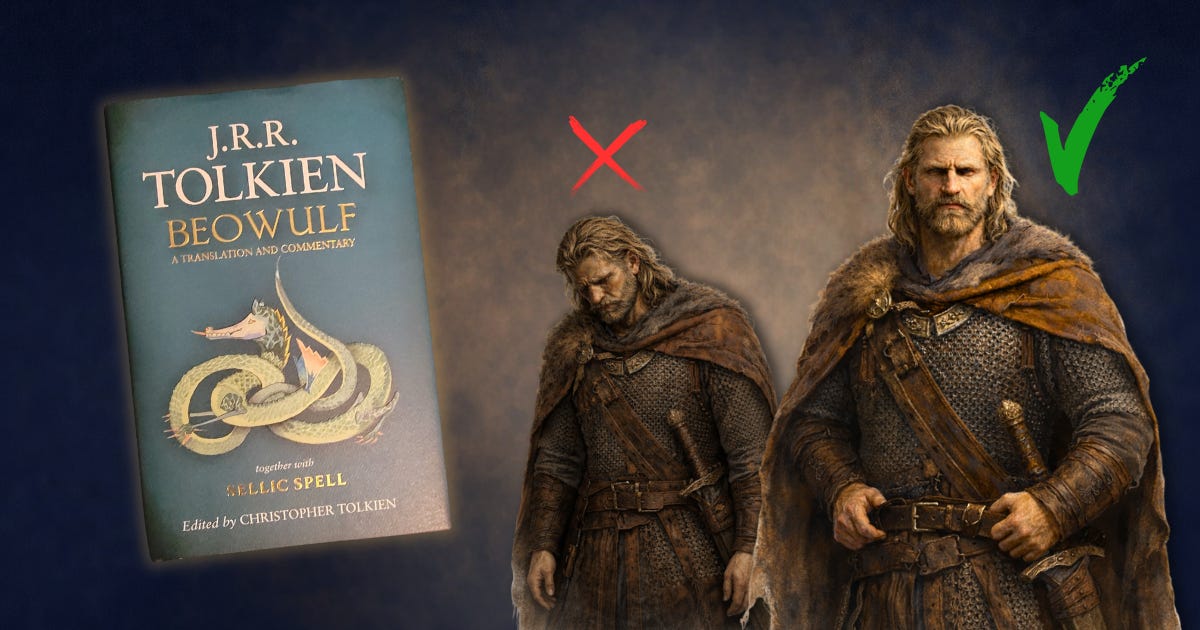
Beowulf sails over the sea to fight an unknown monster.
Does he have courage? Yes, of course. What hero wouldn’t?
But he has another important element that makes him a hero we can learn something from. I call it the cousin of courage—and it can help us as Christian dads to be better examples, and to pass the same down to our kids.
“What Do They Got That I Ain’t Got?”
When I was 13, I found myself high up on a rock outcropping in Arkansas. As I peered over the edge, I seriously considered jumping.
Now, the reason I was mulling that over was because all the other kids who were playing at the lake that day had already done it. But I stood there, hesitant and jittery.
I had shown courage before. My mom’s coworkers nicknamed me Evil Knievel because of all my bike accidents. I was not afraid to take risks on my bike. I’d flown down steep hills at car speeds and wiped out, ending up with road rash on half my body. I’d faceplanted while attempting to jump from a short wall. Fortunately, it was into sand. But I always got back on the bike.
Courage (even foolish courage) hadn’t been a problem before. But now I found myself standing before this tall drop over a lake, hands trembling and breathing in rough bursts.
To quote the Cowardly Lion, “What do they got that I ain’t got?”
What was I lacking? What did Beowulf and those other kids have that I didn’t at that moment?
The simple answer is confidence.
What is Confidence?
Confidence is not a virtue like courage. I call it the cousin of courage because it’s related, but it’s not the thing itself. A healthy dose of confidence can fuel the courage, making it easier to express bravery.
Think of it like a catalyst that makes a chemical reaction stronger or faster. Confidence is not the thing itself—but it adds energy or removes barriers.
Like virtues, there can be an excess of it. We’ve all seen people who are cocky. If they’re overconfident in the intellect, they end up as the know-it-all. If they perceive a physical skill too highly, they won’t accept critique, and we end up with the horror of American Idol auditions.
Sometimes confidence jumps skillsets. We’ve all seen successful people think their ability will simply transfer to a new effort—like actors who think their popularity means anybody cares about their illogical political positions.
Just as virtue can fall into vice through lack as well as excess, confidence suffers from being too weak. We’ve all seen people without much confidence being shy, reserved, timid, or fearful. That can look like social anxiety. But it’s also the kid who’s afraid to try something new because it looks too hard or scary, like taking off the training wheels (or cliff jumping.)
Breaking Down Beowulf’s Confidence
We see Beowulf’s confidence to face the monster Grendel in his vow.
“This did I purpose when I went up upon the sea and sat in my sea boat amid my company of knights, that I wholly would accomplish the desire of your people or would fall among the slain fast in the clutches of the foe. A deed of knightly valor I shall achieve, or else in this mead hall await my latest day.”
Beowulf, lines 513-19 translated by J.R.R. Tolkien
He does not say, “I’d like to cleanse Heorot,” or, “I hope I can vanquish the ogre.” He expresses it as a confident purpose. The intent of his will is to wrestle to the death. You don’t take on a challenge like that unless you’re confident of a chance for victory. I wrote on his risk analysis here:

Beowulf’s certainty helps us see the root of the word. Confidence is related to trust. In fact, the word breaks down into con “with” + fidere “to trust.”
If you trust something will happen, like the sunrise, you have confidence in it. If you pay someone upfront for a job, you have confidence that they will finish it. If you have done something before, you have confidence that you can do it.
Our ultimate confidence is in God through faith. He recognizes that we also live in the real world and will have to put our trust in other people to get things done. We must also learn our own capabilities and limits so that, like Beowulf, we can take on noble deeds with courage and a healthy dose of confidence.
I’m sure you’d prefer not to end up frozen at the top of a metaphorical cliff with your career at risk because you were overconfident.
The Building Block of Confidence: Experience
Gaining confidence comes from one primary source. Experience.
Why do we trust God? At first, because we’re told he’s good, then we trust him more after he carries us through some trouble.
Why was I afraid to jump at 13, even though it was just into water? Because I had never done it before. I had never jumped from that height. The closest I had come was from a diving board that was only half the height of that rock. It was scary because I didn’t know if I could clear the rocks, and if I did, I didn’t know if it would hurt to hit the water. And every kid knows that “from a high enough fall, water is as hard as concrete.”
All the other kids grew up jumping from this spot. They knew where to aim and how far to jump to get past the rocks. I didn’t.
Why was Beowulf so confident that he’d risked his life? As he told King Hrothgar, he’d already fought and killed over a dozen monsters. That gave him confidence to tackle this one. However, he doesn’t fall into cockiness (like some of the modern adaptations tell it).
Read his vow carefully. He recognizes the possibility of failure and death.
So, his confidence is tempered by reality as well. He realizes that he had beaten some monsters before, but he’d never beaten an undefeated, ogre-like, land creature like Grendel.
He realistically knew there was a chance he might die, but his record said he had a good shot at victory and glory.
The Confidence Challenge in My Writing
I’ve been working through this process as I write the next book in The King of The Caves series. It’s a completely different story, so I have to draw on the work of other writers as a guide, while also reminding myself that I’ve written a book before, so it can’t be that different.
Meanwhile, my protagonist, Kurian, is working through his own learning curve with a new role and responsibilities he wasn’t prepared for. Unfortunately for him, he doesn’t have a good example, but he does have counselors.
Want more from Imago Dad? Subscribe for weekly articles on faith, fatherhood, and masculinity through classic stories.
Know someone (especially a dad) needs encouragement?
Loved this post and want to say “thanks” with a tip? Make a 1-time contribution below. (No subscription needed!)
How to Grow Confidence
Both stories we’ve been exploring offer insights into out how to grow your confidence.
1. Break down hard things into smaller steps. Think of the first monsters that Beowulf fought as small steps of training for Grendel. Likewise, Grendel becomes preparation for his fight with the dragon later.
You grow the muscle of confidence by breaking down a big challenge or goal into smaller steps and mastering those steps one at a time.
Say you want to learn to play the piano after hearing Rachmaninoff. You’re never going to get far if you start trying with that piece. You’ll struggle, be disappointed, and quit.
But if you break it down and start by learning a few notes and scales, you can master the basics. Early on, you play Chopsticks and get confident at that. That leads you to play Heart and Soul. That provides confidence for a harder song, leading to another, all the way up the chain of difficulty until you can attempt Rachmaninoff. Even then, you won’t master it in one sitting.
Confidence grows with those small steps. If it’s cliff jumping, start with a small one, then move up.
That Arkansas rock was probably 10 feet. Here’s Crater Lake in Oregon, thirty years later, at about 35 feet.

2. Learn from others’ experiences. Other men had tried to fight Grendel, and they had failed. Beowulf knew from their experience that blades wouldn’t hurt the creature. He needed to try something different, so he goes bare fisted against his foe.
I learned from watching those other kids jump into the lake.
That’s wisdom—learning from others’ experience before we’re forced to learn from our own mistakes.
When we see somebody else do a hard thing, it sparks our own confidence, and sometimes courage as well. “If they can do it, why can’t I?” whispers in our minds.
My most famous example is Roger Bannister breaking the four-minute mile. Nobody had run a four-minute mile before. He proved it could be done and soon a bunch of people followed.
3. Transferring confidence to new settings. Beowulf was fighting monsters in both cases, so transferring confidence between types of creatures seems simple.
For us, it’s not always that easy. Attempting a new endeavor, a new skill, a new field of study, often saps confidence.
The trick is to find the overlap from past successes. That can boost your confidence to overcome those first hurdles.
Say you’re a software engineer. It’s very technical but it’s all digital and you want to move into mechanical engineering. Well, both are technical so you can have confidence that there’ll be some overlap in thought or process.
The harder jump is between technical skills and soft skills, like communication or the arts.
Sometimes that seed of confidence sprouts from the bare fact that you’re a rational human who has learned other skills before—and this will be a similar learning process.
How to Teach Our Kids Confidence
The same pattern to grow your own confidence works with kids. If your kids are walking, you’ve seen the pattern before:
Teach them to break things down into smaller steps that don’t look so hard.
Help them push through the challenge of small failures.
Give them examples to follow: yourself, characters in stories, or other people you know.
Inspire them with the benefits of achieving their goal.
Help them apply earned confidence in new situations.
That last one’s the tricky part.
Kids are great at looking at the end point of effort or experience and saying, “I’ll never get there. I’m bad at this.” It’s your job to intervene, hopefully before that happens, and walk them through this process.
Because we’re adults, we can see the connections that they can’t. So, when your kids are trying something new, show them the connections.
That writing naturally follows reading. That movements transfer between sports with small shifts. That talking with adults is about the same as talking to mom and dad. That learning to live peacefully with siblings is a lot like being a good friend. Etc.
Most importantly, that they were smart enough to learn one thing, so with effort they can learn another.
Why Confidence Matters Long Term
Ultimately, confidence can be a catalyst for any virtue—not just courage. As we engage those virtues, we learn how to live them out better through each success and failure. We can develop healthy confidence in each through experience and practice.
My encouragement to you: Build up your own confidence and pass it down to your kids.
This essay began as a walking rough draft. See it on YouTube.
Plans for Beowulf:
I’ve got a handful of other essay topics I’m working on from Beowulf. Here’s the potential list:
Confidence: The Catalyst of Courage (This essay)
Using the Right Tool for the Job: Words and Swords, Wealth and Shields
Dealing with Evil: Both Human and Monstrous
Generational Respect
Leaving a Legacy
The Rare Gift of True Loyalty
I don’t know if all of these will become essays, but Beowulf holds all of them in a portrait of virtuous manhood.
After they’re released, I’d love to share a live discussion of the book with anyone who is interested.
Want to win this hardback copy of Beowulf and some other cool stuff?
Share or comment on any of the Beowulf essays and stay tuned for details.
Support:
This publication is reader-supported, and I’m genuinely grateful for every one of you.
If this piece was helpful or encouraging, the simplest way to support the work is to like, comment, or share it. That tells me what’s resonating and helps this reach other dads who need it. Sharing with a friend or family member is especially meaningful.
If you’d like to support Imago Dad more directly, there are a few ways to do that—no pressure, just options:
1 - Become a paid subscriber
Paid members help sustain the long-term work here and will be getting some exclusive resources for Christian dads.
2 - Read my fiction
I have a couple books of fantasy fiction for older teens and adults here, or you can get a free sampling on my sub-Substack, Stories & Pictures
Be on the lookout for my upcoming children’s book, Dog Knights and The Orb of Power
3 - Make a one-time contribution If you really loved this article or want to support Imago Dad, you can send a one-time contribution below. You choose the amount. No subscription needed!
In addition to Imago Dad, Brandon Wilborn writes speculative fiction with spiritual themes. Find his previously released books at BrandonWilborn.com
Disclosure: Links on this page may be affiliate links. If you choose to purchase anything through them, it will not change your price, but may support the author.
I love pieces like these that intelligently break down words and phrases we all share. Came away with a much richer understanding of confidence, and faith.
Confidence is competence embodied..